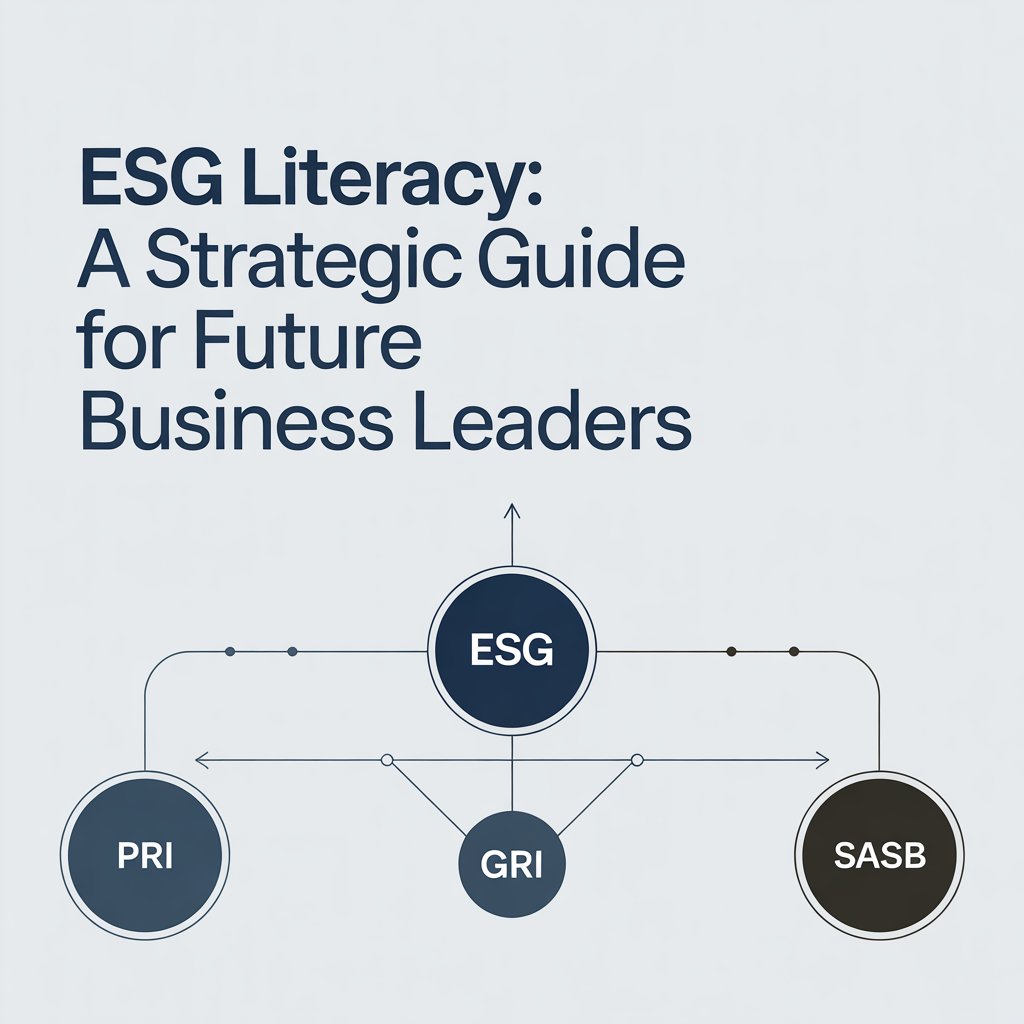
Abstract: As Environmental, Social, and Governance (ESG) is becoming a primary focus for corporate valuation, the pedagogical crisis in business schools is likely to increase. Although many big giants are now engaging in sustainability reporting, the significant difference between technical corporate disclosures and theoretical academic literature still exists. This essay proposes an ESG Integration Framework in business education that would integrate the UN Principles for Responsible Investment (PRI), Global Reporting Initiative (GRI), and Sustainability Accounting Standards Board (SASB) standards. Rather than treating ESG as an optional ‘add-on’ course, business schools should include it in the core curriculum. The main objective is to equip future business leaders with ESG literacy. This is necessary to operate in a business environment where non-financial performance is inevitably bound to the long-term fiduciary duty.
Introduction
At present, 99% of S&P 500 companies are publishing ESG reports. But a major portion of MBA graduates are still unaware of how to use these reports, as they lack the basic required skills and understanding to read these disclosures. According to the KPMG Survey of Sustainability Reporting (2024), with 95% of the world’s top 250 companies, sustainability reporting has transitioned from a niche practice to “business as usual.” Nevertheless, this has created a pedagogical gap. Teaching materials are either too technical in nature, as corporate compliance forms, or too abstract and jargon-filled as scholarly articles. Students are often left with confusion without any guidance on how to overcome these obstacles. This essay argues that business schools have to implement a combined model that imparts PRI, GRI, and SASB standards in a way that students can understand while retaining academic rigour.
The Three Major Frameworks
To achieve ESG literacy, students must distinguish among the three primary pillars of the current ecosystem, each serving distinct stakeholders and purposes.
UN PRI: The United Nations Principles for Responsible Investment (PRI) represents the “buy-side” of the ESG equation. The PRI has more than 5,000 signatories with assets under management of up to 139.6 trillion. It offers institutional investors a model in which ESG factors can be integrated into the analysis of the investment. For students, the six principles of the PRI demonstrate that ESG integration is not merely an ethical endeavor but also a risk management technique. By focusing on the financial materiality of sustainability, the PRI teaches students how to use ESG data as an instrument of financial valuation to protect long-term returns in an increasingly complex global market.
GRI: The Global Reporting Initiative (GRI) is the world’s most popular sustainability reporting scheme. It is adopted by 78% of the 250 largest global companies. As compared to Investor-Centric Models, GRI focuses on how a company’s operations directly affect the environment and society. By studying the GRI framework, students learn the mechanics of corporate transparency and how to track specific indicators of operational influence.
SASB: The SASB Standards identify financially material sustainability risks and opportunities across 77 specific industries. This ensures disclosures are tailored to a company’s unique sector. This framework is an essential instrument for accounting students and strategy students studying how to assess the enterprise value by directly connecting ESG factors to cash flows and cost of capital. The SASB Materiality Finder allows students to identify which sustainability challenges affect the bottom line of a business, such as the safety of their data or water management. This training bridges the gap between traditional financial reporting and industry-aligned corporate strategy.
Critical Analysis: Identifying “Greenwashing”
One of the most important skills for a business student is the ability to identify “Greenwashing.” This means a company makes misleading claims to appear more environmentally friendly than it actually is.
Why would companies do this? This is mainly because it is expensive for any company to be truly sustainable and requires many changes in the way business is conducted. In order to avoid these costs and, at the same time, to attract the attention of green investors and environmentally friendly consumers, some companies apply the practice of glossy marketing and ambiguous wording to disguise their true environmental impact. They take a risk that the people will not take a closer look to verify the truth.
However, by using the GRI Standards and SASB Materiality Maps together, students can perform a “stress test” on these corporate claims.
For example:
- The GRI Standard forces companies to present concrete data on waste and emissions. This prevents them from using empty buzzwords like “all-natural” or “eco-friendly” without evidence.
- The SASB Framework helps students to identify distractions. For instance, a giant tech firm boasts of recycling paper in its offices (a relatively simple task). Nonetheless, they remain quiet about the enormous amount of electricity consumed by its data centers (a very large and costly issue). A student trained in this framework would immediately recognize this “distraction” as a warning sign.
By learning these tools, students will stop believing in fancy brochures and become active auditors who can hold a company accountable for its true impact.
Industry Comparison: Tech vs. Banking
To understand how to use these frameworks, students must realise that materiality varies according to the sector. While the UN PRI provides the overarching motivation for investors to look at these companies, the GRI and SASB provide the specific data points that differ between the sectors.
Let’s understand with one hardware industry and the financial service industry:
For Apple Inc. (Hardware Industry): To measure Apple’s total metric tons of e-waste, a student can use GRI 306: Waste Standard. At the same time, applying the SASB Hardware Standard, a student would prioritize “Product Lifecycle Management” and “Supply Chain Labor.” Further, they would search Apple’s ESG Report for specific data on recycled cobalt and labor audit results from foreign manufacturing plants.
For JPMorgan Chase (Financial Services): For this type of service, students use GRI 201: Economic Performance standard to track the bank’s community investments. Further, by following the SASB Commercial Banking Standard, the focus shifts entirely to relevant issues for the same services under environment, social capital, human capital, business model and innovation, and leadership and governance.
Through the delivery of these industry-specific benchmarks, business schools abandon the one-size-fits-all ethics approach and adopt an industry-aligned strategy.
The Gap in Current Education
Even though these frameworks are common, business education lacks cohesion. Recent research by Vítečková & Houdek (2025) shows that many ESG initiatives in higher education have a “limited impact on student values.” This often encourages “virtue signaling” rather than a shift in management mindset.
There are three primary barriers:
- Siloed Curricula: ESG is frequently treated as an optional elective or a standalone “add-on.” However, AACSB Insights argues that for sustainability to be effective, it must be embedded across all core functions, from finance and accounting to human resources, moving away from a “narrow profit lens.”
- Inaccessible Materials: There is a significant disconnect in resources. Corporate ESG reports are very lengthy and compliance-focused, making it difficult to analyze in the classroom. Whereas academic journal articles may be too abstract to be practically applied by students to the actual business setting.
- Lack of Standardization: Current teaching models often lack cross-disciplinary integration frameworks. For instance, Students learn GRI or SASB as independent subjects. But they fail to understand how GRI and SASB can be applied complementarily to provide a 360-degree view of corporate health and societal impact.
Proposed Solution
To address these barriers, there is a three-level Integration Model:
- Level 1 – Core Curriculum:
Instead of developing new courses, ESG standards can be integrated into existing core modules. For example, UN PRI can be incorporated in Finance courses to impart knowledge on risk management, and GRI in Accounting modules to impart knowledge on transparency. This guarantees that all students, irrespective of their major, consider ESG as a core business discipline and not a choice of major.
- Level 2 – Practical Application:
At this stage, students move from theory to “stress-test” real-world data. Using a multi-framework approach, students are allotted a task to audit a company’s annual report, complying with SASB Industry Standards. This level focuses on critical thinking, such as whether the student can identify gaps between a company’s marketing claims and its actual financial materiality.
- Level 3 – Professional Mastery:
Students aspiring for sustainable finance or ESG consulting, this level offers advanced training in climate modeling, social impact auditing, and TCFD (Task Force on Climate-related Financial Disclosures) reporting. By this time, a student is not just aware of ESG, but they also start implementing these frameworks in a corporate setting.
Conclusion
Business education needs to keep pace with the development of the global market. Business schools are faced with the challenge of balancing between technical corporate reports and the theory in academic articles. Including PRI, GRI, and SASB in the core curriculum will not only result in the creation of ESG specialists, but also ESG-literate leaders will be able to make informed, sustainable, and financially viable decisions in a complex global economy.
References
- AACSB Insights. (2025, November). Business schools can shape a sustainable future. https://www.aacsb.edu/insights/articles/2025/11/business-schools-can-shape-a-sustainable-future
- Apple Inc. (2025). Environmental Progress Report 2025. https://www.apple.com/environment/pdf/Apple_Environmental_Progress_Report_2025.pdf
- Governance & Accountability Institute. (2025). 2025 sustainability reporting in focus: S&P 500 trends. https://www.ga-institute.com/research/research/sustainability-reporting-trends/2025-sustainability-reporting-in-focus/
- Global Reporting Initiative. (2016). GRI 201: Economic performance 2016. https://www.globalreporting.org/publications/documents/english/gri-201-economic-performance-2016/
- Global Reporting Initiative. (2020). GRI 306: Waste 2020. https://www.globalreporting.org/publications/documents/english/gri-306-waste-2020/
- Global Reporting Initiative. (2022a). A short introduction to the GRI Standards. https://www.globalreporting.org/media/wtaf14tw/a-short-introduction-to-the-gri-standards.pdf
- Global Reporting Initiative. (2022b). Four of the five largest global companies report with GRI. https://www.globalreporting.org/news/news-center/four-in-five-largest-global-companies-report-with-gri/
- Global Reporting Initiative. (n.d.). The GRI Standards. https://www.globalreporting.org/standards/
- IFRS Foundation (SASB). (2024). SASB materiality finder: Commercial banking (FN-CB). https://sasb.ifrs.org/standards/materiality-finder/find/?industry%5B0%5D=FN-CB
- IFRS Foundation (SASB). (n.d.-a). Download SASB standards. https://sasb.ifrs.org/standards/
- IFRS Foundation (SASB). (n.d.-b). Human capital project and standard updates. https://sasb.ifrs.org/standards/process/projects/human-capital/
- IFRS Foundation (SASB). (n.d.-c). SASB materiality finder. https://sasb.ifrs.org/standards/materiality-finder/
- KPMG. (2024, November). Business as usual for the world’s top companies as they get ahead of mandatory sustainability reporting rules. https://kpmg.com/xx/en/media/press-releases/2024/11/business-as-usual-for-worlds-top-companies-as-they-get-ahead-of-mandatory-sustainability-reporting-rules.html
- Principles for Responsible Investment (PRI). (n.d.-a). About the PRI. https://www.unpri.org/about-PRI
- Principles for Responsible Investment (PRI). (n.d.-b). What are the Principles for Responsible Investment? https://www.unpri.org/about-us/what-are-the-principles-for-responsible-investment
- Task Force on Climate-Related Financial Disclosures (TCFD). (n.d.). TCFD publications and resources. https://www.fsb-tcfd.org/publications/
- Vítečková, M., & Houdek, P. (2025). The rise of business education, the ESG revolution, and the limited impact on students’ values. Interchange. https://www.researchgate.net/publication/390574619_The_Rise_of_Business_Education_the_ESG_Revolution_and_the_Limited_Impact_on_Students’_Values
 Sundhara
Leave a comment