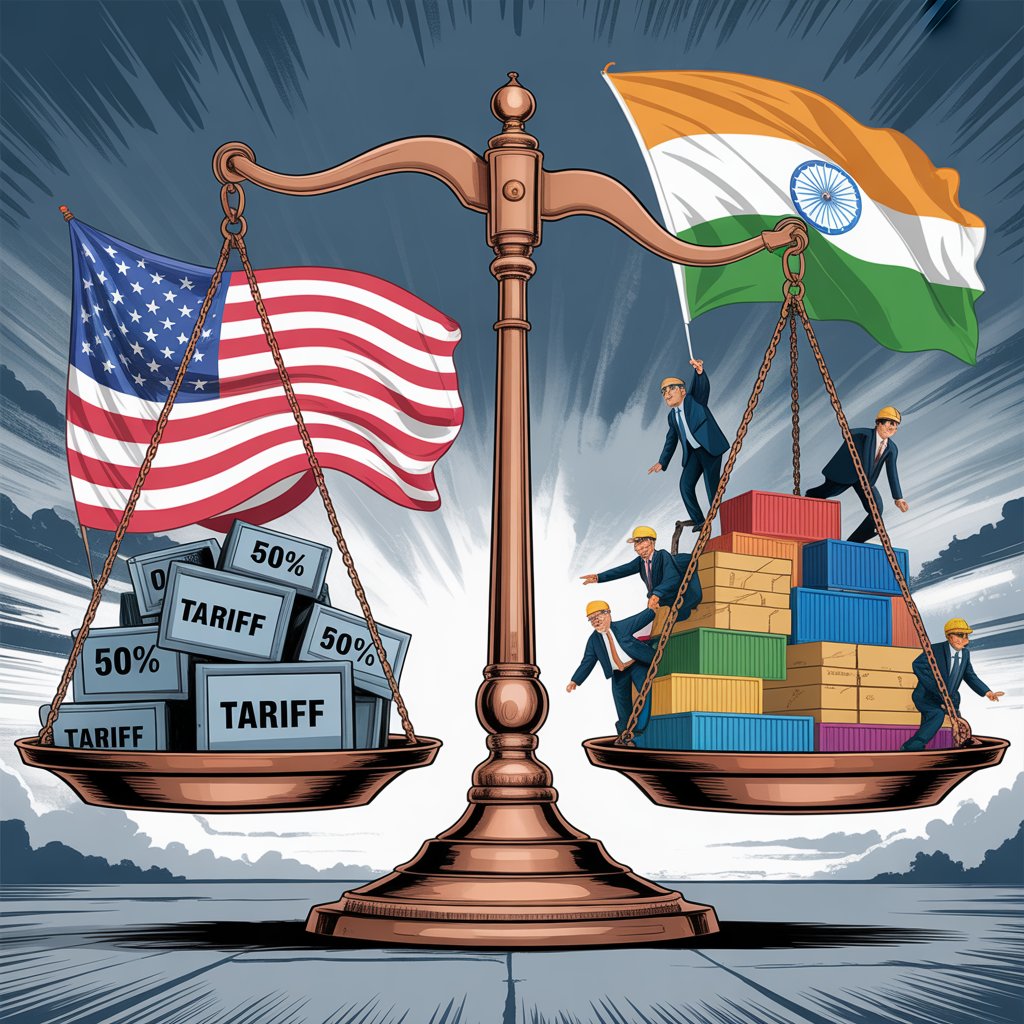
It was July 30, and the President of the United States, Donald Trump, had announced 25% tariffs w.e.f. August 07 on all imports of Indian goods. Further, on August 06, he announced an additional 25% tariffs on imports from India w.e.f. August 27.
Although both countries share a good bond, the reason mentioned for this move is to punish the country for buying Russian oil. It is obvious that it is going to affect billions of dollars’ worth of trade. This will not only impact trade between the two countries but also several sectors in India, like IT, services, and manufacturing. The effect of tariffs will go beyond only import-export numbers.
Additionally, this strategy is not random. The U.S. President, Donald Trump, had previously planned this approach, as it had already been implemented in China and is now being applied to India. Global trade has become a great reason for geopolitical pressure.
Let’s explore how it will impact the GDP of India. How will the Government of India react to Trump’s move?
The U.S. Tariff Playbook
It all started in 2018 when Trump imposed tariffs on all imports from China. His purpose was to reduce the trade deficit of America, as he took this as Unfair Trade practices.
However, China did not sit in silence. It stood stronger by diverting its trade and reducing dependency on the U.S. dollar. The country has also increased its investment in its own technologies. Trade tensions became the new normal between the two giants.
The final scorecard of China showed mixed results. On the one hand, politicians claimed victory, but local citizens started to pay higher prices for each commodity. Businesses learned to fear sudden changes in policy. This scenario had created global uncertainty.
India is now facing a similar pressure. According to Trump, India’s rising exports to the U.S. are another ‘imbalance’ and need correction. According to the latest sources, as of March 2025, India’s exports to the US totaled approximately USD 86.51 billion worth of goods. These largely include engineering goods, electronic goods, drugs and pharmaceuticals, Gems and Jewelery, Chemicals, and textile products.

GDP Under Pressure
If a 50% tariff by the U.S. on India served for an extended time, then the Analyst predicted that the GDP of India could be impacted between 0.4% and 0.8%. Though the numbers seem too low, it will highly disrupt employment opportunities.
Let’s look further at what could be the short-term and long-term impact on India’s growth.
Sectors that are heavily dependent on U.S. exports, viz., textiles, gems and jewelery, leather, footwear, and chemicals, are facing either order cancellations or shipment delays. Dr S.K. Sundaram, the chairman of The South India Mills Association, stated that the U.S. Tariff will impact 70% of the textile export. This will directly disrupt the thousands of job opportunities.
The initial 25% tariff on India by the U.S. was manageable. However, an additional 25% had disrupted Indian exporters. Labor-intensive industries like textiles, gems, footwear, and chemicals are left with either paying an even higher price, and have their profit margins reduced dramatically, or losing potentially profitable contracts in U.S. markets to competitors. These competitors are Vietnam, Bangladesh, and China, which pay much lower duties. Such a blow is especially severe for smaller companies that lack the financial cushions and scale to absorb these sudden cost shocks.
The long-term damage would definitely be on Foreign Direct Investments and Foreign Institutional Investors. If we can elaborate on this statement, then FDI is highly sensitive to the policy stability of any country. According to Moody’s Ratings 2025, persistent tariffs may shake India’s manufacturing growth. Additionally, FIIs are also far more sensitive and vulnerable than FDI. Global investors avoid investing in the country when exports slow down and earnings decrease.

Sectoral Impact
Manufacturing & Exports
The effect of tariffs directly falls on goods trade. Highly reliable sectors like textiles, gems and jewelery, seafood, leather, and furniture are at risk. Exporters have observed a drastic decrease in margins. But they are trying hard to remain competitive in the American market. For instance, over 40,000 employees are affected due to this disruption in the terry towel industry situated in Solapur.
Nomura stated that 30 to 40% of the Indian export is subject to these tariffs. Hence, in case the duties are not lifted, GDP growth can be reduced to 6%.
Services & IT
The IT sector has also suffered indirect damage. The increase in the cost of operation in the U.S. can cause companies to cut back on the outsourcing budgets, which slows down growth for Indian IT service providers. Indian companies are already reporting that U.S. customers are hesitant about new deals in the wider-level uncertainty.
Another risk problem is also the USA visa policy tightening, which further restricts the flow of Indian qualified professionals and increases the expenses of technological companies that are accustomed to on-site executions.
The timing creates cruel irony. Just as digital transformation opens new opportunities for Indian companies, political tensions threaten traditional revenue streams. Companies built on cost efficiency suddenly question their fundamental value proposition.
MSMEs
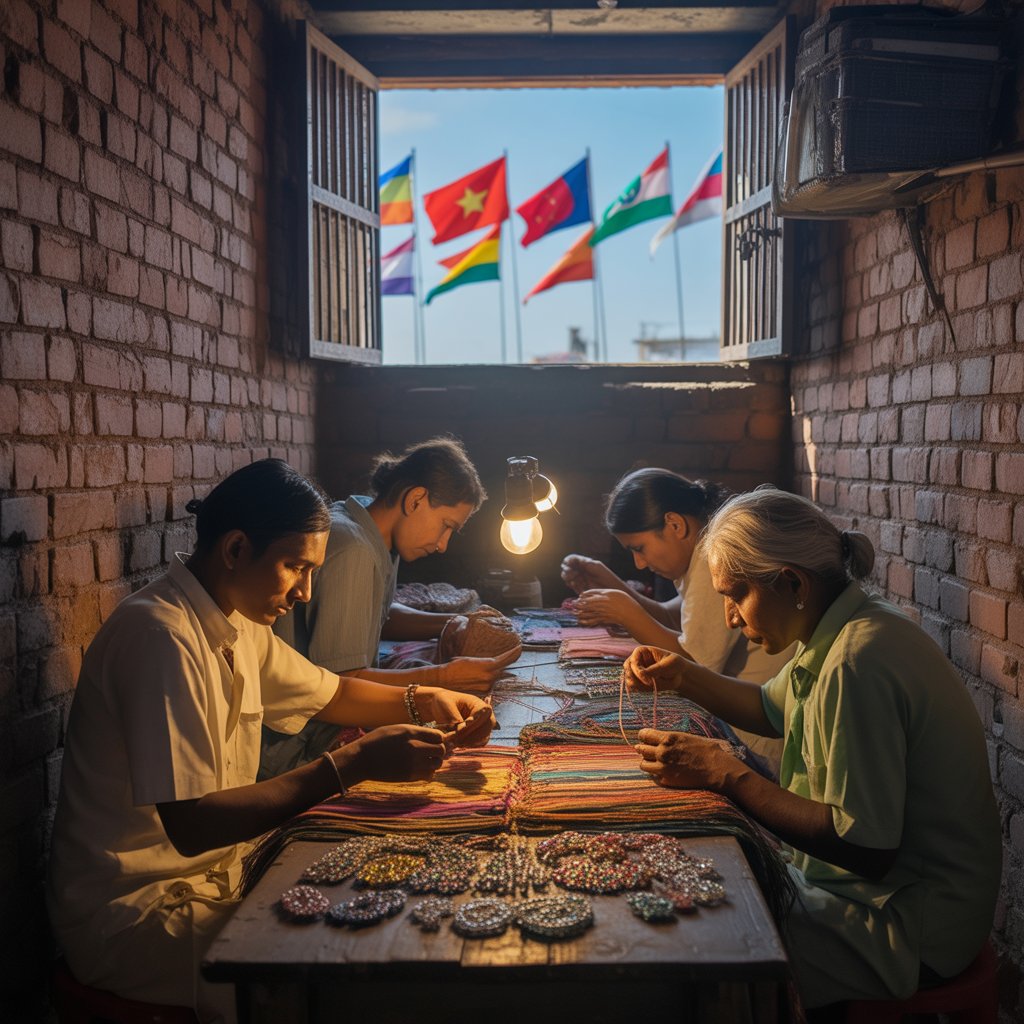
The weakest area is the micro, small, and medium businesses (MSMEs) in India. These companies, most of which are in the textile, gems, leather, and handicraft sectors, do not enjoy diversified markets or a financial buffer like bigger exporters. As the U.S. purchasers withdraw, numerous MSMEs have a cash-flow crisis.
● More than 50,000, out of almost 60 million MSMEs in the entire country, small exporters are trying to adjust to the shock of the 50% tariffs by trying to identify other markets in Europe, Africa, and Asia. Many hastened to pre-ship products in time to save their U.S. contracts, despite escalating prices and complexity.
● This trade shock is not only costly in the form of lost orders, but it also costs in the form of bank credit tightening to small firms. As the uncertainty increases and accelerates the liquidity pressures, financing to export-oriented MSMEs is being postponed or withdrawn by banks.
● To add to the problem, other industries, including textiles, diamonds, chemicals, and spices, are losing their market share in the world market. Competition is high because MSMEs are competing with other countries that have significantly low tariffs, including Bangladesh, Vietnam, Indonesia, and even Latin America.
Will India be able to diversify exports to escape the U.S. Tariff Trap?
India has been attempting to find alternative opportunities that may provide a cushion to the nation in terms of exports and investments in response to the US tariff crisis.
The EU, UK, ASEAN, Middle East, and Africa are the regions where the export interest is active because exporters are seeking an alternative channel to ship goods via bilateral trade agreements and value chains that bypass the U.S. restrictions.
Additionally, the India-UAE Comprehensive Economic Partnership Agreement, which is already in operation, is being reviewed to improve and increase exports to the Gulf region. India has also renewed its initiative to enhance its relations with Australia and EFTA countries.
The government is also focusing on ongoing PLI schemes, particularly in industries such as electronics and pharmaceuticals, to intensify production and create volume towards diversified export markets. Multilateral tools such as iCET (the Initiative on Critical and Emerging Technology) are also adopting strategies to strengthen the tech relationship between India and the U.S. in indirect support of market resilience.
Nevertheless, it is not easy to redirect the exports as Indian exports are facing several logistical challenges. Longer shipping times and huge costs, new regulatory and compliance environments, and new demand patterns in new markets are other issues to deal with.
Well-established competitors such as Vietnam enjoy the advantage of strong FTA networks and infrastructure preparedness. It developed a strong presence in Asian supply chains, such as the European Union-Vietnam Free Trade Agreement, and the ability to export. It is also revealed by global economic research that those economies whose export bases are broad both in terms of product and destination have a greater ability to withstand external shocks.
The Diplomatic Balancing Act
Tariffs damage relationships far beyond trade numbers. U.S.-India cooperation spans defense partnerships, energy projects, and educational exchanges. Washington has been trying to create a closer relationship between the two, but a 50% duty might disturb it. Political cooperation becomes poisonous when politicians present each other as economic enemies.
This is an especially problematic timing in the face of the increasing assertiveness of China. The mutual advantage of the two countries is an alliance at the level of dealing with similar challenges. The existence of trade wars complicates the legitimacy of public cooperation at home. Political leaders are being pressured to be hard instead of being cooperative.
WTO disputes offer a solution, yet they are too slow to respond to quick business requirements. Nevertheless, firms need immediate solutions to issues concerning prices and contracts. The multilateral trading system appears not to be enough to resolve speedy bilateral tensions. Neither side wants to appear weak while negotiations drag on.
India needs to decide which type of battle to negotiate concessions and be ready to fight a long-term battle. Both of these alternatives are associated with domestic political costs. Concession may appear as a sign of weakness, and conflict may destroy other mutually beneficial relationships that both nations cherish.
Final Thoughts
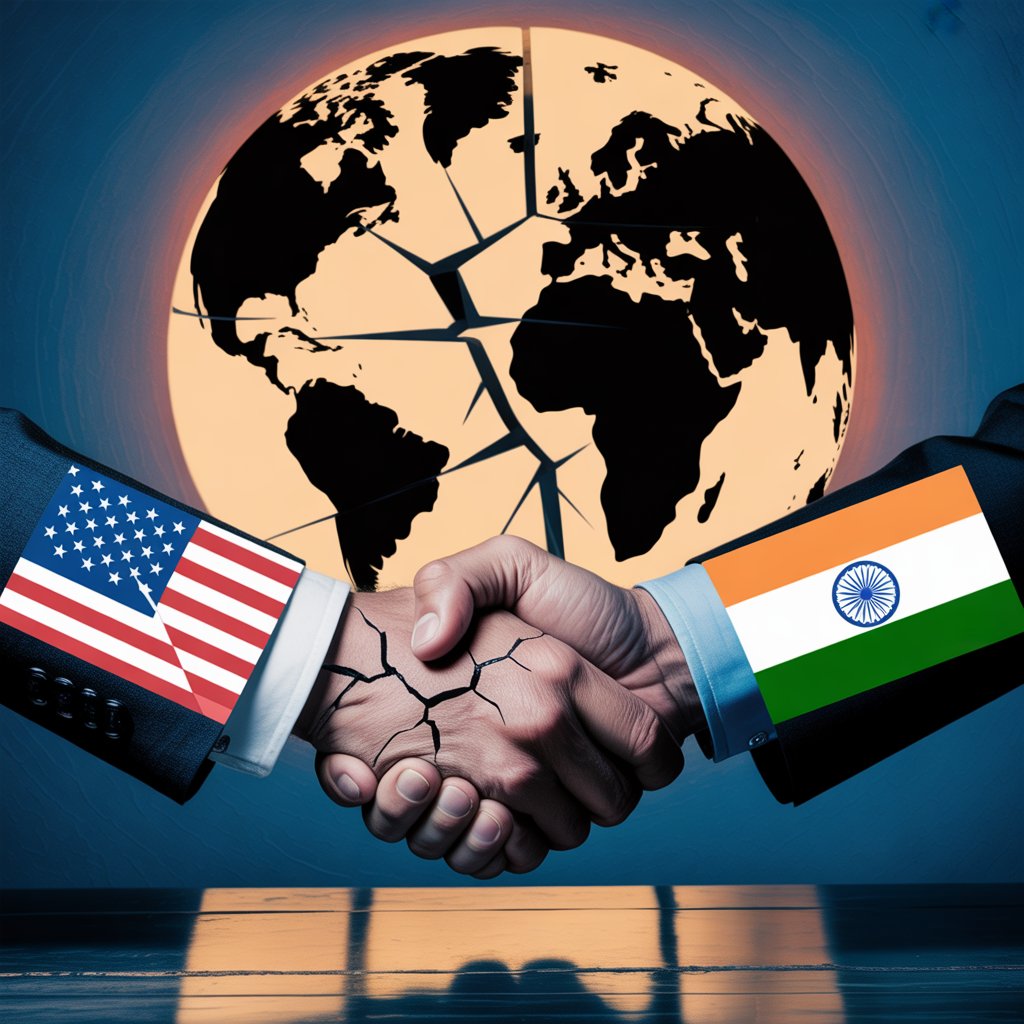
Tariffs function as both economic obstacles and diplomatic tests. They quantify the extent of the financial pain that countries will absorb to hold on to political offices. They also determine whether strategic partnerships can be sustained when short-term interests are in conflict with long-term cooperation objectives.
India needs a two-fold approach that would secure the interest of the stricken industries and not leave important ties with the Americans. This is an act of assisting troubled exporters by subsidizing and market access initiatives. It is also the act of maintaining political channels so that they can work together later on when political winds blow.
Agile policymaking is one of the secrets of economic resilience in this age of political tariffs. Companies may require governmental support in finding new clients and in adapting to the diverse market demands. The retraining of workers is required in cases of permanent changes in traditional industries. Diplomats should be able to find imaginative ways to allow both parties to save face.
References
- https://www.thehindu.com/business/Economy/trump-tariffs-india-donald-trump-pm-modi-live-updates-august-27-2025/article69981899.ece.
- https://www.thehindu.com/business/Economy/how-indias-youth-can-challenge-us-tariffs/article69951434.ece.
- https://www.cnn.com/2025/08/27/economy/trump-india-tariff.
- https://gulfnews.com/business/markets/india-braces-for-50-percent-tariffs-as-trump-upends-ties-with-modi-1.500246588.
- https://www.japantimes.co.jp/commentary/2025/07/17/world/china-winning-trumps-trade-war/.
- https://www.cnbc.com/2025/08/07/india-isnt-flinching-why-trump-might-be-misreading-indias-tariff-playbook.html.
- https://www.cnbc.com/2025/08/07/indias-nearly-87-billion-exports-to-us-under-threat-due-to-trump-tariffs.html.
- https://timesofindia.indiatimes.com/business/india-business/trump-tariffs-prolonged-50-duty-could-cut-indias-growth-by-up-to-0-8-next-round-of-trade-talks-important-says-morgan-stanley/articleshow/123180182.cms.
- https://www.cnbctv18.com/economy/us-tariff-india-impact-gdp-at-risk-job-losses-gst-rate-cut-jpmorgan-19660865.htm.
- https://timesofindia.indiatimes.com/city/coimbatore/us-tariff-will-impact-70-of-textile-and-clothing-industry-sima/articleshow/123571773.cms?utm
- https://www.reuters.com/world/india/trumps-doubling-tariffs-hits-india-damaging-ties-2025-08-27/?utm.
- https://www.reuters.com/world/india/trumps-doubling-tariffs-hits-india-damaging-ties-2025-08-27/?utm.
- https://timesofindia.indiatimes.com/city/ahmedabad/gujarat-manufacturing-sectors-brace-for-impact-as-50-tariff-threat-looms/articleshow/123266008.cms?utm.
- https://www.reuters.com/world/india/moodys-warns-us-tariffs-may-hurt-indias-manufacturing-push-slow-growth-2025-08-08/?utm.
- https://www.reuters.com/world/india/indian-stock-benchmarks-extend-losses-us-tariff-blow-2025-08-28/?utm.
- https://timesofindia.indiatimes.com/city/kolhapur/solapurs-terry-towel-industry-may-struggle-to-absorb-trump-tariff-blow/articleshow/123570097.cms?utm.
- https://economictimes.indiatimes.com/markets/stocks/news/us-tariffs-to-hit-textiles-gems-msmes-hard-gdp-growth-forecast-cut-to-6-nomura/articleshow/123539397.cms?utm.
- https://economictimes.indiatimes.com/tech/technology/ettech-explainer-how-50-us-tariff-could-impact-indias-tech-ecosystem/articleshow/123521487.cms?utm.
- https://theindianeye.com/2025/08/18/tariffs-and-protectionist-policies-impact-on-the-it-industry-and-outsourcing/?utm.
- https://scanx.trade/stock-market-news/global/us-tariffs-to-hit-indian-msmes-hard-textiles-and-diamonds-most-vulnerable/17229794.
- https://economictimes.indiatimes.com/small-biz/trade/exports/insights/indias-small-businesses-scramble-to-cushion-blow-from-trumps-50-tariffs/articleshow/123577078.cms?from=mdr.
- https://www.deccanherald.com/business/us-tariff-impact-msmes-in-textiles-diamonds-chemicals-spices-to-be-most-hit-3697842?utm.
- https://economictimes.indiatimes.com/news/economy/foreign-trade/trumps-50-tariffs-are-here-indian-exporters-scramble-for-survival/articleshow/123545296.cms?from=mdr.
- https://www.pib.gov.in/PressNoteDetails.aspx?NoteId=154945&ModuleId=3.
- https://www.gov.uk/government/publications/uk-trade-strategy/the-uks-trade-strategy.
- https://www.pib.gov.in/PressReleaseIframePage.aspx?PRID=2104450#:~:text=In%20terms%20of%20utilization%20of,one%20being%20in%20October%2C%202024.
- https://www.pib.gov.in/PressReleasePage.aspx?PRID=2088669.
- https://www.pib.gov.in/PressReleaseIframePage.aspx?PRID=2013169#:~:text=TEPA%20would%20accelerate%20creation%20of,renewable%20energy%2C%20Innovation%20and%20R&D.
- https://www.mea.gov.in/press-releases.htm?dtl/37881/Review_Meeting_of_the_IndiaUS_initiative_on_Critical_and_Emerging_Technology_iCET.
- https://gicel.ch/european-union-vietnam-free-trade-agreement-evfta/#:~:text=On%20June%209%2C%202020%2C%20the%20Vietnam’s%20National,responsible%20for%20national%20regulation%20of%20trade%20and.
 Sundhara
Leave a comment