The compliance team is not blocking your content. They are rejecting what should never have been written that way in the first place.
Most wealth management firms don’t have a content problem. They have a content design problem that becomes visible only when compliance steps in.
And having worked inside wealth management and credit environments for nearly a decade, I have seen exactly where that design breaks down. Not at the surface level, but in how content gets written, reviewed, and rejected across teams, long before it reaches final approval.
Where The Process Breaks Down
The majority of the firms in this space have more insights than they ever publish. But very little makes it out, not because ideas are missing, but because approval does not happen.
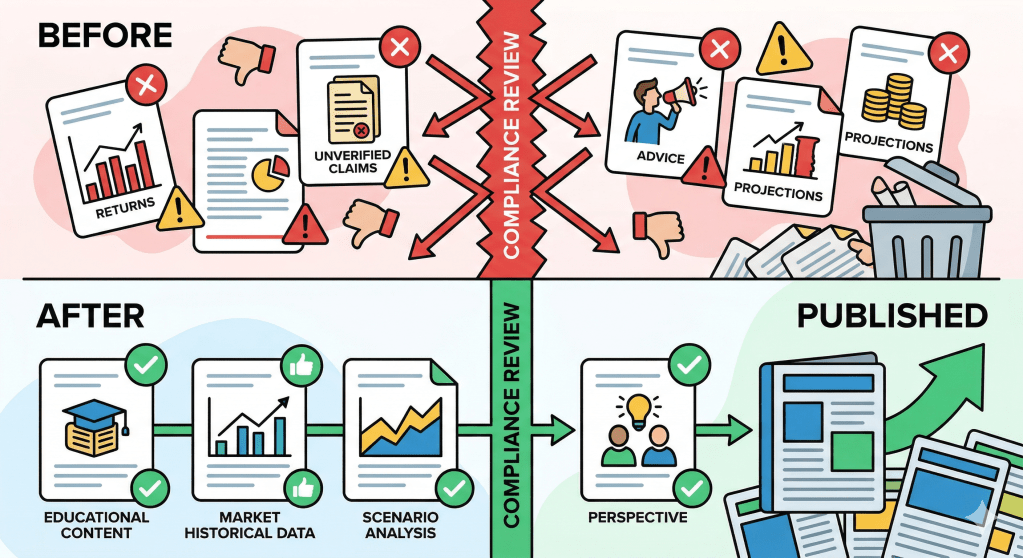
A typical flow looks like this: a marketing-led draft goes to compliance. It comes back flagged, stating reasons such as language, claims, and comparisons. When the second-time writer revises it without fully understanding the issue, again, the content gets flagged by the compliance team.
In most cases, by the time compliance steps in, the content is already too misaligned to fix efficiently. Hence, by the third round, though the content gets technically safe, it gets strategically weak. And this way it never gets published.
This is where most wealth management content quietly fails. I have broken this down further in my blog – What Good Finance Content Gets Wrong.
What looks like caution is often just misaligned writing. And the cost of that silence is rarely acknowledged. Because when your firm does not publish, your audience does not wait. They read someone else’s and form opinions for you.
Silence, in this context, is not risk control. It’s lost visibility.
The Root Cause: Content Written for Marketing, Not for Compliance
The issue does not start with compliance. It starts with how the content is created.
Here’s how it works:
A topic is assigned to a generalist writer who drafts it. Experts polish the writing, but it is filled with projections, simplified claims, or implied recommendations. However, it works completely from Marketing’s perspective but does not hold up under a compliance lens.
In most drafts I come across, the breakdown happens at this exact point, where strong thinking is translated into language that triggers avoidable flags.
Because the restrictions themselves are not unreasonable, regulators such as SEBI in India, the FCA in the UK, and the SEC in the US do not prevent you from publishing the content. They stop you from making unchecked return claims, comparing products loosely, using absolute or misleading language, and presenting advice as education.
None of this limits strong content. It only exposes writing that was not built for this environment. You can check my Finance Content Writing services here.
What Compliance-Aware Finance Writing Looks Like in Practice
The firms that publish consistently don’t ‘deal with compliance better.’ They write differently from the start.
First, they understand the line between education and advice. Most content explains what a financial strategy is. But the good content explains how that strategy behaves when markets do not perform well. This change is important because it builds trust without triggering risk.
Second, they build authority through perspective, not prediction. Instead of forecasting outcomes, they explore scenarios. Instead of promising performance, they explain frameworks. A reader doesn’t need certainty to trust; they simply require clarity.
And this is where most teams don’t notice the gap, until content slows down completely.
Finally, there’s language. Small phrasing choices decide whether the content moves forward or gets stuck. A compliance-aware writer does not sound cautious; they sound precise. They know when to say ‘historically’ instead of ‘will,’ ‘investors may consider’ instead of ‘you should,’ and ‘depending on risk profile’ instead of broad statements.
For instance,
Instead of writing, “this fund has delivered consistent returns across market cycles.”
We can write, “Over the past 20 years, this fund has seen major market volatility and still performed above its benchmark level. Nevertheless, outcomes vary depending on individual risk profile and market conditions.
The Work Behind Getting This Right
This is where my work is different.
As a Wealth Relationship Manager handling HNI client portfolios, I worked directly with wealth management clients, understanding what they asked, what they questioned, and where they lost confidence in the content presented to them. Those clients didn’t lose confidence because they lacked financial knowledge. They lose it when the content is loaded with jargon, vague about risk, and missing content related to current market volatility. Every one of those moments was a content failure before it was a conversion failure.
This is what is directly connected with the compliance issues as well. The language that loses an HNI client is the same language that gets flagged in review. Jargon-heavy, absolute, and vague writing triggers the compliance flags that stall your publishing pipeline.
Precision that earns client trust and passes compliance is not two separate standards but is written from a position of understanding both sides.
This is what I bring to every content brief. The content I write does not enter compliance as a draft to be fixed. It enters as a submission built for both the reader it needs to earn and the review it needs to pass.
Final Thought
The firms publishing the most credible content in wealth management are not ignoring compliance. They are building for it before the first draft exists.
If your content is accurate but still not getting published, this isn’t a compliance issue. It’s a signal. The question is not whether your team can write. It’s whether your content is built to survive the environment it operates in.
Is your content process built to publish, or just to draft?If this question has a clear answer, you already know what needs to change. If it doesn’t, that’s where conversation with me usually starts.
 Sundhara
Leave a comment