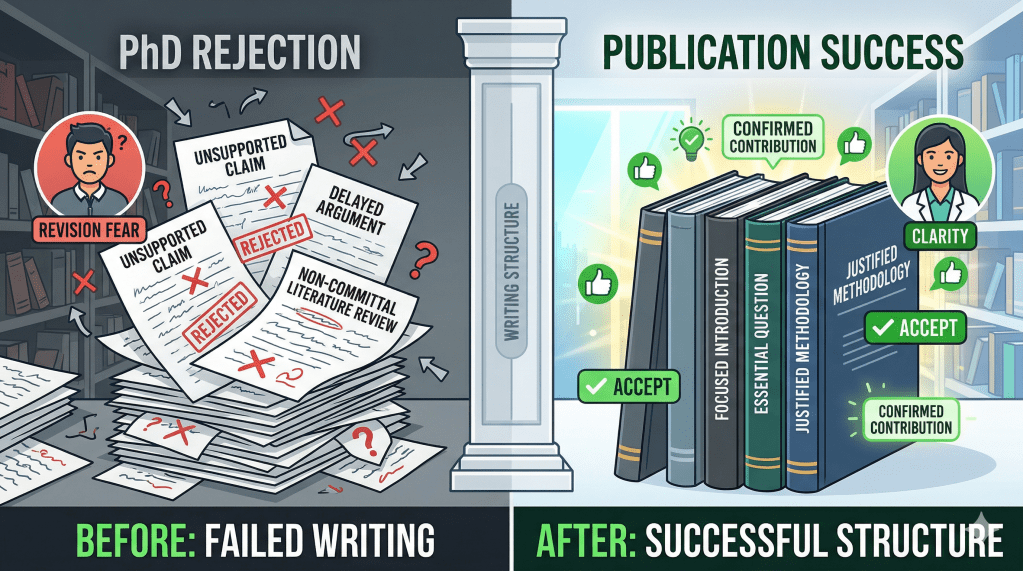
Most PhD papers are not rejected for poor research. They are rejected because the contribution is not clearly visible where reviewers expect it.
This is a structural failure, and it is evident across submissions, where the argument emerges too late, the literature review avoids taking a position, and the discussion reports findings without clearly stating what they actually changed.
By the time the paper becomes clear, the reviewer has already moved on.
Why do PhD students fail to publish?
The paper does not make its contribution visible early enough for evaluation.
Peer review is not a slow or exploratory reading process. At a time, reviewers go through many submissions under strict time pressure, looking for clarity and a strong contribution. When that clarity is delayed, and the contribution is missing, the paper becomes difficult to evaluate and easy to reject.
The Writing Pattern That Undermines Strong Research
Across PhD submissions, a consistent structural pattern appears.
The literature review is thorough but non-committal. It shows familiarity with the field but does not clearly explain a position or justify the need for the research question. The methodology explains the process in detail but does not justify the choices made. The discussion presents the findings but avoids the interpretation needed to turn results into a contribution.
Each section in the paper appears competent. Together, they create a complete paper but lacks direction. Therefore, the consequence is predictable. By the time, reviewer finishes reading without a clear answer to a simple question: What does this paper change?, the decision is already leaning toward rejection.
What is the biggest writing mistake in PhD papers?
Treating a journal paper like a dissertation chapter.
A dissertation is designed to demonstrate depth and coverage. A journal paper is designed to present a focused argument efficiently. When PhD students carry their dissertation habits, such as extensive context, exhaustive citation, cautious positioning into journal papers, the central argument becomes harder to locate.
This is not a problem of research quality. It is a mismatch between format and structure.
What Structurally Strong Papers Do Differently
Papers that move through peer review successfully are not necessarily more complex. They are more deliberate in how they present their argument.
The introduction establishes direction early. In the opening section, the problem is specific, the gap is clearly defined, and the contribution is stated. The reader does not have to search for purpose.
Secondly, the literature review builds a necessity. Instead of listing existing work, it leaves the research question unresolved. This shifts the paper from informative to essential.
Thirdly, the methodology focuses on decisions. It explains why the chosen approach fits the research question, making the reasoning behind the process transparent and accessible.
Lastly, the discussion takes a position. It links findings to what they confirm, challenges, or extend to the field. Only data reporting is not enough. Interpretation is what turns results into contributions.
Diagnosing a Rejected Paper
Most revisions focus on improving sentences. This rarely changes the outcome.
Structural problems cannot be solved at the sentence level. They require reworking how the argument is built and presented throughout the paper. For this, a more effective method is reverse outlining. Summarise the function of each paragraph in one line, then read those lines in sequence. If the argument does not progress clearly, the structure does not support the paper.
Apart from this, the reviewer’s comments can also be taken constructively. For instance, “Unclear contribution” means the argument is not visible where it should be. “Weak framing” means the motivation has not been established early enough. Interpreting feedback this way turns revision into a targeted process to improve clarity.
Where I Work Differently
Most academic editing improves how a paper reads. That is rarely what changes a publication decision.
When a paper may contain a strong contribution, but if it becomes clear only in the discussion, the earlier sections fail to support it. By then, the reviewer has already assessed the paper as incremental.
That is not a writing flaw. It is a positioning failure within the paper itself.
My role is to identify precisely the points where the argument loses force, where the structure delays clarity, and where the paper asks the reader to do unnecessary work, and to restructure the draft so that the contribution is visible, supported, and difficult to dismiss, as part of an academic writing and editing approach.
In peer review, a paper is not judged solely on its content. It is judged on how easily its value can be recognized.
Final Thought
For many researchers, this becomes visible only after a rejection—or when a draft feels complete but not convincing.
That is typically the stage where writing needs a different kind of attention.
I work with PhD students and researchers to improve the structure of their papers, making the argument clearer, the sections more coherent, and the writing more supportive of the work.
If you are preparing a submission or revising a paper, you can share your draft for review. I will identify where clarity, flow, and organization can be improved before you move to the next step.
 Sundhara
Leave a comment