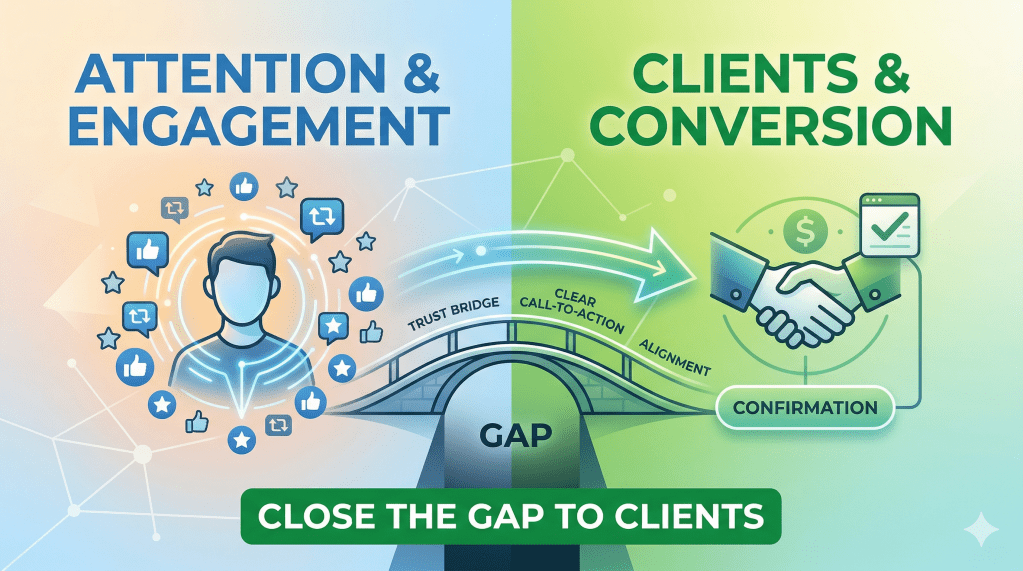
You published something last week. It did well. It has got decent engagement, a couple of shares, maybe a comment that said: “This is so true.” And then the week moved on, and your inbox stayed exactly where it was – no inquiry, no conversation, no client.
If this is a pattern you recognize, the problem is not in your content. It is the strategy behind it. And this particular gap, between content that earns applause and content that earns clients, is exactly what I help fix.
When Engagement Becomes a Vanity Metric
Likes and comments on your every post may sound like progress. A reader can save it and also reshare it with a colleague. But still, they never reach out. Not because they are not impressed, but because nothing in your post can actually address their problem. Engagement tells you people agree with you, but this does not guarantee they are ready to work with you or hire you.
If your content strategy is optimized for engagement rather than conversion, you are building an audience. Not a client pipeline. Those are two very different outcomes, and it is worth being honest about which one you are actually working on.
There is also the “be helpful” trap. Brands are told to provide value, so they do, and readers consume it happily and move on. Helpful content that does not point back to what you specifically offer is a public service, and not a business strategy.
The Four Gaps Between Attention and Conversion
In my experience, content that looks healthy on the surface but quietly underperforms commercially almost always has one of these four problems.
The reader doesn’t know what you sell. When content is too topical and does not go deep enough to address the readers’ pain point, they leave without knowing what you actually do. Every piece I write makes it clear, without being promotional and losing your original brand voice, what business you are in and who you serve. My writing leaves readers with: this person solves exactly this problem, for someone exactly like me.
There is no next step. Most content ends where the action should begin. The reader agrees, closes the tab, and disappears because your content has no clarity to guide them about the next step. It can be a detail of services, or a simple brochure download, or a warm CTA that says, if this is your situation, this is worth a conversation. I build that moment into every piece, at exactly the point where intent shifts.
The content attracts the wrong reader. Think about a founder publishing weekly on “content strategy.” He has earned good traffic and consistent output, but zero conversions. Because the readers are students and curious generalists, not decision-makers with a budget. I write in a way that is specific enough for the right person to immediately feel, “This is for me.” Content that is focused on a niche may attract fewer readers, but it brings in more of the right people. That trade-off is almost always worth it.
There is no trust bridge. A reader who enjoyed your post is already interested. To closes the gap between interest and conversion is evidence like specific thinking, clear articulation of outcomes, and a voice that consistently signals genuine understanding. I built that layer in, so by the time someone reaches your call to action, they are not wondering whether you understand their problem. They already know you do.
How I Write Content That Actually Converts
I don’t just write content and hand it over. I first understand what a specific reader should think, feel, and do by the end of the piece, and then I write in a way that leads them to that outcome. Every structural choice, transition, and CTA is created to support that goal.
I maintain my clients’ tone and intent in every piece I write, which matters more than most brands realize. A reader who has been following your brand for a few months should not be able to tell which content you wrote and which I wrote for you. That consistency is part of what builds trust over time, and trust is what eventually converts.
I also write with narrative flow, because information alone does not keep people reading, a story does. When a reader stays with your content from the first line through the last, they arrive at your CTA with clarity, confidence, and a clear reason to take action. That journey does not happen by accident. It is designed in that way.
What This Means for Your Business
For D2C brands, startups, and B2B service firms that are building their content presence, the gap between attention and conversion appears later than expected. In the beginning, engagement feels like real progress. But a few months later, although the content is performing well by all visible metrics, revenue is not increasing with it.
The solution is to create content that is aligned with your buyer, your offer, and the decision you want them to make. That is the work I focus on. Not writing as an output, but writing as a business tool.
Is Your Content Doing Anything More Than Building Awareness?
If you are publishing consistently and still hearing silence from the clients you actually want, the strategy needs to be looked at, not the volume. The right content, written for the right reader, with the right structure, does not just get attention. It gets chosen.That is what I help emerging brands, growing businesses, and ambitious founders achieve. If that is the gap you are sitting with right now, it is worth a conversation.
 Sundhara
Leave a comment