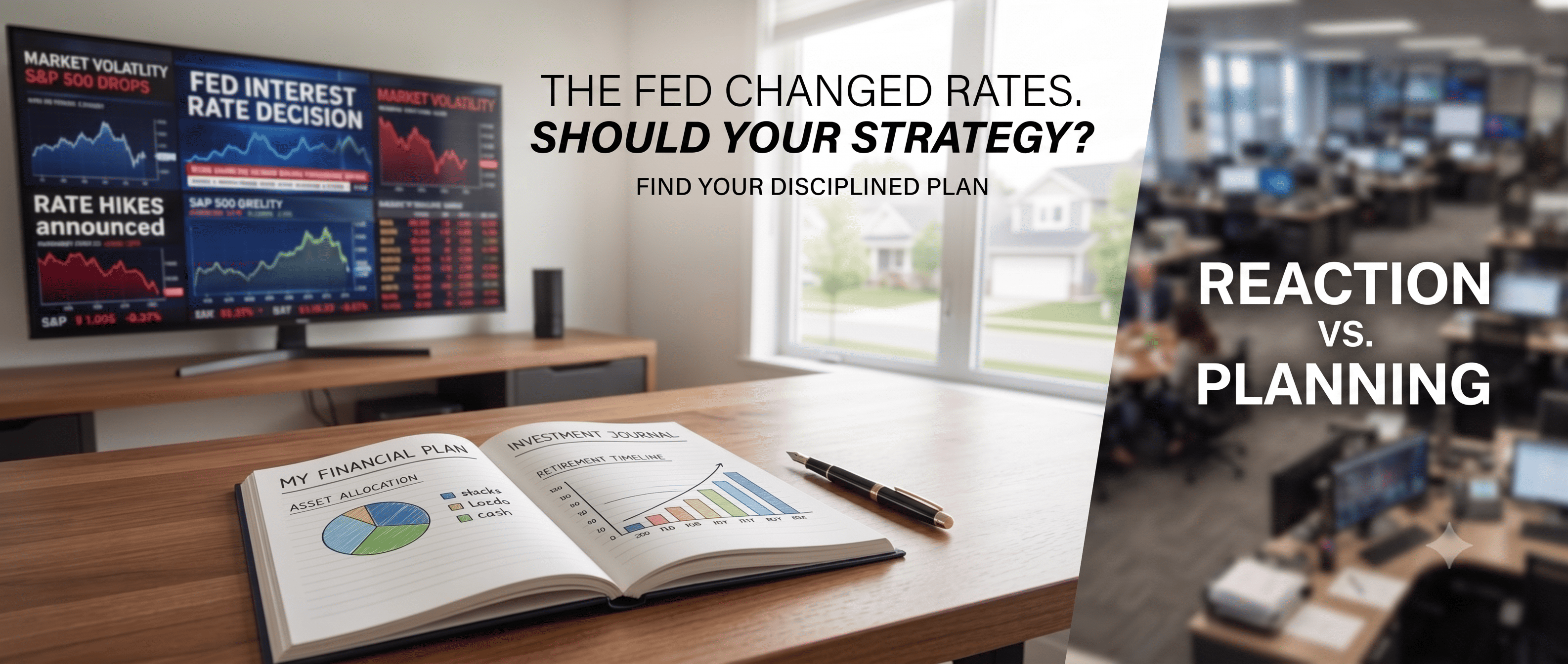
Every time the Federal Reserve makes an announcement, many investors ask the same question: Do I need to update my existing portfolio now?
It’s a fair question to ask. Because Federal Reserve meetings dominate financial headlines, many retail investors feel pressured to act even when their long-term financial goals remain unchanged.
Here’s what those headlines may not tell you: Investors with long-term goals are the ones who resist making frequent portfolio changes during an interest rate cycle. They already have answers to these questions: what your money is for and when you will actually need it.
Interest rate decisions do not require an automatic change to your investment strategy. They require better questions. Before making any changes, it’s worth understanding what a rate decision actually means for your accounts, what history tells us about previous Fed rate reversals, and the four questions to ask before you touch your portfolio.
Why Every Federal Reserve Announcement Feels Like a Call to Action
Every Fed announcement is treated as a major market event. Within minutes of the announcement, the headlines appear, and the media fills the rest of the day with assumptions. The volume of coverage can make investors feel as though it demands an immediate response, even when nothing has to do with the portfolio they hold in their 401(k) or brokerage account.
Two behavioral biases make that urge even stronger. First is recency bias, which makes the latest news feel more important because it’s the most recent information they have seen. And the second is loss aversion, which makes the prospect of losing money feel painful, so headlines about rate hikes often carry more emotional weight than those about steady market growth.
During my time in wealth relationship management at one of India’s largest private-sector banks, I noticed one pattern that had nothing to do with the country or the currency. Whenever a major market or economic event dominated the headlines, clients would call, worried about money they had already invested.
However, every one of those conversations ended the same way: back at their long-term goals, time horizon, and risk tolerance. Investor psychology does not change at the border. A Federal Reserve decision triggers the same reaction in a 401(k) investor in Ohio as an RBI announcement does in a mutual fund investor in Mumbai.
While rate announcements can influence markets, they don’t automatically change an investor’s financial goals or investment strategy.

How Federal Reserve Interest Rates Influence Your Investments
The Federal Reserve determines the federal funds rate, the rate at which banks borrow money overnight from other commercial banks. This is the same rate that impacts mortgage rates, credit card APRs, savings account interest rates, and the market value of almost every bond in your portfolio.
The Fed does not move this rate arbitrarily. It monitors the Consumer Price Index (CPI), a monthly data from the Bureau of Labor Statistics. It also monitors the unemployment rate and monthly payroll growth. Additionally, it measures inflation through the Personal Consumption Expenditures (PCE) price index released by the Bureau of Economic Analysis. When inflation remains elevated, the Fed tends to hold rates higher. As inflation moderates, it has more flexibility to lower rates.
When the Fed raises rates, newly issued Treasury bills, notes, and bonds offer higher yields. As existing bonds pay lower rates, they become less attractive and hence, their market prices fall. On the contrary, when the Fed cuts rates, existing bonds with higher locked-in yields offer more price support, and market prices rise. As a result, the value of a bond fund in your 401(k) can rise or fall even though it continues to hold the same bonds. That’s because the market value of those bonds changes as interest rates move.
While bonds respond immediately to changes in interest rates, cash behaves differently depending on where it sits. Interest rates on high-yield savings accounts and money market funds generally move in line with changes to the federal funds rate. A Certificate of Deposit works differently: it locks in a fixed rate for a set term, so a CD opened before a rate cut continues to pay that higher rate until it matures.
By contrast, the stock market responds to fluctuations in the fed rate less directly. Higher rates lead to an increase in the cost of corporate borrowing, which can slow expansion plans and lower profit margins, particularly for companies that carry heavy debt. Lower rates can ease that pressure by reducing borrowing costs and improving financial flexibility.
Nonetheless, interest rates are only one element that impacts stock prices. Investors also pay close attention to what a Federal Reserve decision signals about the broader economy. The same rate cut can push stocks higher in one situation and lower in another, depending on whether investors see it as a sign that inflation is easing or that the economy is slowing. That’s why looking beyond the headline is just as important as understanding the rate decision itself.
The Biggest Investment Risk May Be Reacting Instead of Planning
We can understand this by studying two cycles that happened in the past:
From March 2022 through July 2023, the Federal Open Market Committee (FOMC) raised its target rate eleven times, from near zero to a range of 5.25% to 5.50%. Mortgage rates roughly doubled over that period. Existing bonds lost value as new issues came to market paying higher yields. Money market funds and high-yield savings accounts had paid almost nothing for years, but suddenly paid 4% to 5%. As a result, cash became a meaningful part of many investors’ portfolios again.
The Federal Reserve kept interest rates at that same level for more than a year before making a shift. The Fed then cut rates three times between September and December 2024 to ease monetary policy. Then, it was unchanged for almost the first half of 2025 to monitor economic data and again lowered rates three more times during the second half of the year. By December 2025, the target range had fallen by 175 basis points to 3.50%–3.75%, where it remained until the June 2026 meeting.
Some investors rebuilt their portfolios after nearly every Federal Reserve announcement, believing each announcement required immediate action. Others simply monitored their portfolios, rebalanced when necessary, and stayed focused on their long-term financial goals. Over time, the second group was better positioned because their investment decisions were guided by discipline rather than fear-driven decisions. The rate path was volatile. Their process was not.

Federal funds rate (upper bound), 2022–2026. Source: Federal Reserve press releases.
When Should You Change Your Investment Strategy After a Fed Rate Decision?
A Federal Reserve rate decision may prompt you to review your portfolio, but your financial goals should always drive your investment strategy. Before making changes to any account, four questions matter more than the headline itself. To see how this works in practice, consider three hypothetical investors: Emily, 30; David, 50; and Linda, 68. Each at a different stage of life, the same Federal Reserve decision affects them differently.
Has your goal changed?
Emily contributes to her 401(k) every paycheck and holds most of it in a low-cost S&P 500 index fund. Her goal is retirement in roughly three decades. A quarter-point interest rate move changes nothing about that goal, so it changes nothing about her allocation.
Has your time horizon changed?
David is saving for retirement while also setting aside money for his daughter’s college tuition, due in four years. Those two goals sit on different timelines inside the same household, but call for different answers. He won’t need his retirement savings for at least another fifteen years, giving them more time to recover from market fluctuations. But his daughter’s tuition bill, due in four years, has a much shorter time horizon and calls for a more conservative approach.
Money needed within the next five years can be invested in short-term Treasury securities, CDs, or a high-yield savings account, not in anything that could lose 15% of its value in the year before the tuition payment is due.
Has your liquidity need changed?
Linda retired last year and now uses about $4,200 from her portfolio each month to supplement her Social Security benefits. Unlike Emily and David, she depends on her investments to cover everyday expenses. That’s why she splits one to two years of everyday spending money between a high-yield savings account and short-term Treasury securities. This gives her access to instant liquidity whenever she needs it.
Has your risk capacity changed?
Risk tolerance is more about emotions than appetite. How comfortable are you with market volatility? How much volatility can your time horizon and financial situation absorb? Emily has high capacity because she has about three decades to recover from a downturn. Linda has a lower risk capacity because she relies on her investment portfolio to help cover her living expenses. David’s risk capacity depends on the time horizon for each financial goal.
None of these four questions mentions the Fed funds rate. That’s the point. A Federal Reserve rate decision may encourage you to review your investment strategy, but the answers should come from your own financial circumstances.
What to Review When Interest Rates Change
A movement in interest rates is a good reason to review your accounts even when nothing feels urgent. Three areas are worth checking whenever the environment shifts, in either direction:
Start by reviewing your idle cash. Money left in a checking account or brokerage sweep account often earns little interest. Moving cash you won’t need immediately to a high-yield savings account or money market fund may provide a better return. The right choice depends on when you will need the money, not simply on the highest available interest rate.
Next, review your fixed-income investments. Make sure your bond holdings still reflect your financial needs rather than simply offering the highest yield. Short-term Treasury bills are generally appropriate for money you will need within a year or two. If you are ready for long-term investments, Treasury notes or a laddered mix of maturities may be a better fit. Investors in higher tax brackets may also consider to park their funds in municipal bonds because the interest they earn is generally exempt from federal income tax.
Lastly, review your retirement contributions. This is worth doing every year, regardless of what the Federal Reserve does. For 2026, the IRS set the 401(k) employee contribution limit at $24,500 and the combined IRA contribution limit at $7,500. Individuals age 50 and older can also make an additional $8,000 catch-up contribution, allowing them to save more for retirement each year.
The same IRA contribution limit applies whether you choose a Traditional IRA or a Roth IRA. The decision comes down to when you want the tax benefit. If you are already reviewing your accounts after a Federal Reserve rate decision, it’s a good opportunity to confirm you are on track to maximize your annual contributions. Over the long run, consistent contributions have a far greater impact on wealth creation than reacting to a single interest rate decision.
Taken together, these checks are just portfolio maintenance: confirming your diversification and your allocation still fit your goals.

The Rate Decision Can Wait
Every Federal Reserve meeting will generate new predictions, market commentary, and opinions about what investors should do next. Some forecasts will prove accurate. Many won’t. But none of them can tell you what you are investing for, when you will need your money, or how much investment risk is appropriate for your situation.
Your financial plan guides those decisions.
Whether you are building retirement savings, preparing for a major expense, or generating income in retirement, long-term investment success depends more on following a disciplined process than on responding to individual market events.
If this article leaves you with one habit, let it be this: before making changes after the next Federal Reserve announcement, revisit your financial plan first. The rate decision can wait.
A quick note on why this article is built the way it is: Financial content works when it’s accurate enough to trust and clear enough to act on. That’s the standard I follow when writing for banks, wealth management firms, fintech companies, and other financial services brands.
If your firm needs finance content that reads like this, built on sourced facts and a real decision framework, not filler, explore my Finance Content Writing Services or get in touch.
Federal Reserve Interest Rates: Frequently Asked Questions
How long does it typically take for Federal Reserve interest rate changes to affect the economy?
Not all at once. Savings account and money market yields shift within a few weeks. Mortgage and loan rates catch up over the following one to two months. The slower effects on hiring, spending, and company earnings can take six to twelve months to show up in the data.
Which sectors tend to benefit from higher interest rates?
Banks tend to gain the most, since a wider gap opens up between what depositors pay and what they charge borrowers. Utilities and other debt-heavy sectors usually experience the opposite: their borrowing costs rise while their revenue continues to grow at roughly the same steady pace.
What’s the difference between nominal interest rates and real interest rates?
The nominal rate is the interest rate shown on a loan or bond. The real rate adjusts for inflation to show your actual return. For example, if you earn 5% and inflation is 4%, your real return is about 1%.
Can Federal Reserve interest rate decisions affect ETFs?
Bond ETFs are generally more sensitive to changes in interest rates than equity ETFs, since bond prices tend to move inversely to interest rates. Stock ETFs move too, but through investor expectations about the economy and borrowing costs, not a direct mechanical link. For long-term investors, an ETF’s role in your investment strategy and overall asset allocation matters far more than reacting to any single Fed announcement.
How do changes in the Federal Reserve interest rate affect index funds and individual stocks?
Both are affected, but not in the same way. An index fund holds hundreds of investments, so changes in interest rates typically have a more balanced effect. Individual stocks can experience larger price swings, especially if the company has higher debt levels.
How do interest rate changes affect mortgage refinancing decisions?
Mortgage rates often begin changing before the Federal Reserve announces its decision because markets adjust based on expectations. Whether refinancing makes sense depends on the new interest rate, the closing costs, and how long you plan to keep the loan.
References
Federal Reserve issues FOMC statement, June 17, 2026
Federal Reserve Implementation Note, July 26, 2023
Federal Funds Target Range (DFEDTARU), FRED, Federal Reserve Bank of St. Louis
Consumer Price Index, U.S. Bureau of Labor Statistics
The Employment Situation, U.S. Bureau of Labor Statistics
Personal Income and Outlays (PCE price index), U.S. Bureau of Economic Analysis
401(k) limit increases to $24,500 for 2026, IRA limit increases to $7,500, Internal Revenue Service
Published July 2026 | This article is not meant to direct your specific financial decisions. It is not personalized financial, investment, tax, or legal advice. Consult a licensed financial advisor or tax professional about your individual situation. Emily, David, and Linda are illustrative composites used to explain a decision framework; they are not real individuals. Data on Federal Reserve policy, inflation, employment, and retirement contribution limits is based on publicly available information and is subject to change after publication.

Written by Sundhara, a finance and business content writer with 9+ years in banking. As a Credit Officer at Bank of Baroda she assessed corporate and retail credit risk, and as a Wealth Relationship Manager at ICICI Bank she managed HNI and UHNI portfolios. With an MBA in Finance, she writes research-backed, compliance-aware content across finance and fintech, business and brand. Her work pairs real industry experience with editorial precision.