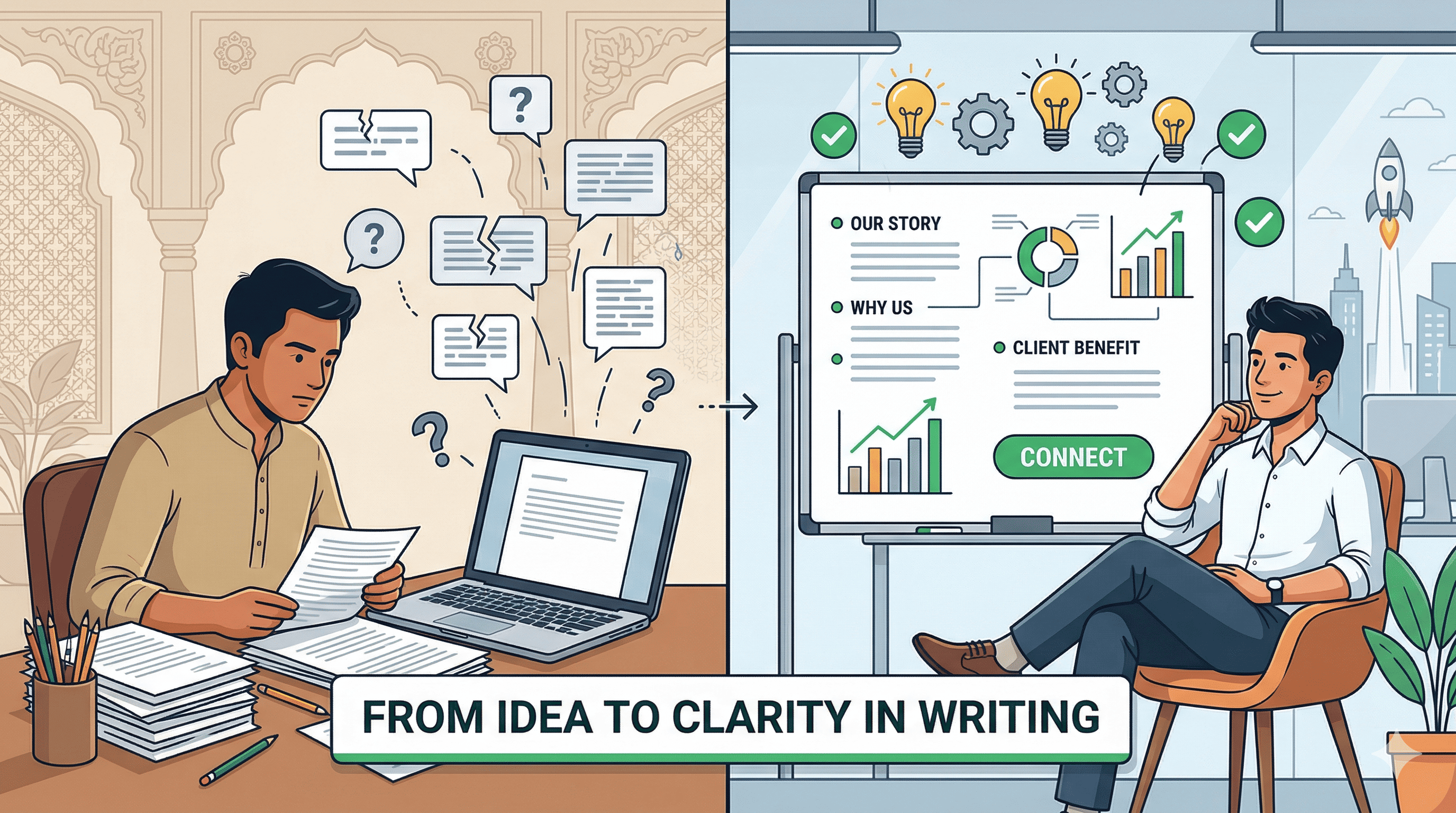
You can explain your business clearly in a conversation. You handle objections, answer hard questions, and close clients who came in skeptical. But when that same clarity needs to show up in writing on your website, your LinkedIn profile, your investor pitch, something shifts. The words lose precision. The sharpness disappears. The business that sounds compelling in a room starts to look ordinary on a page. This is a pattern I have broken down earlier when content gets attention but fails to convert.
This is one of the most consistent patterns I see working with Indian startup founders as a business content writer. And it has nothing to do with the quality of the idea.
The Clarity Gap: What You Know Does Not Become What the Reader Understands
Most founders struggle to put their ideas into words in a way that a person who doesn’t know their business can understand. When you have lived inside a business for more than 3 years, certain things feel too obvious to explain. In other words, founders often stop explaining things that feel obvious to them but may be unfamiliar to their audience.
Research by Nielsen Norman Group shows that users often leave web pages within 10 to 20 seconds if they do not find a clear value proposition. If the first sentence on your page does not speak directly to your reader’s situation, they are already gone.
So when they write their business content, some important context may get skipped. Decisions that took months to arrive at are summarised in a single line. Important distinctions are implied rather than stated.
From the inside, this feels efficient. From the outside, it reads as incomplete, and an incomplete message creates hesitation rather than confidence. The gap between what a founder means and what a reader understands is often just one or two missing sentences. But that’s precisely where people lose interest, and when they don’t understand, they don’t take action.
I learned this pattern long before writing became my profession. In nine years in banking, my job was to take something dense, a credit assessment, a financial product, a risk, and make it land clearly enough for a client to decide with confidence. The lesson stuck: clarity is not about saying more; it is about recognizing the point where the reader stops following you.
My work as a business content writer starts at that gap. Not by adding more words, but by identifying exactly where a message loses its reader and restructuring it around how that reader actually processes information, weighs options, and decides, without losing the brand voice and intent of the business.
Why This Gap Is More Visible in Indian Businesses
Indian founders rarely operate in a single, uniform market. They are usually doing several things at once:
- Adapting global ideas to local behavior. (e.g. a global SaaS sells “annual subscriptions,” but the Indian buyer wants to start with a free trial and decide month to month.)
- Selling to audiences with uneven awareness. (e.g. X already knows what a “neobank” is; Y has never heard the word but needs the same service.)
- Navigating buyer hesitation that rarely gets voiced directly. (e.g. X says “let me think about it” when X actually means “it’s too expensive”.)
Hence, the content should not only be about explaining a product. It has to:
- build context,
- reduce doubt, and
- signal credibility.
This is where most startup content in India weakens, because the content leaves too many unanswered questions. An Indian B2B buyer rarely tells you what made them hesitate. A D2C customer does not explain why they closed the tab. They simply move on. The business never hears the objection. It only sees the lost opportunity. This is why startup content has to do more than describe what you offer. It has to answer the questions, concerns, and doubts readers may never voice before deciding to leave.
The Three Places Your Content Loses the Right Client
1. It describes the product but not the decision
Most content does a good job of describing the product. But it stops before answering what the buyer actually wants to know:
“Is this the right choice for me?”
When that question remains unresolved, the reader understands, but does not act. This is where most content quietly fails.
2. The words everyone uses (that help no one decide)
Words like “Trusted,” “Customer-focused,” and “Tailored solutions” appear in almost every competitor’s copy. They are not wrong, but they don’t help anyone make a choice.
A strong content strategy for Indian startups requires identifying the contrast that actually matters to a buyer, what is genuinely different about how you work, what you prioritize, or what you refuse to compromise on, and making that contrast specific and visible.
3. Softening that quietly weakens your expertise
Many founders soften their writing to sound balanced and approachable. They add extra words, avoid strong statements, and over-explain, but that actually creates the opposite effect.
Expertise comes through in what to say directly, not in how thoroughly every angle is covered.
One unclear About page is the difference between an enquiry and a bounce. When I work with a founder, I look for three things that are almost always missing:
- The process – what it actually looks like to work with you.
- The proof – a specific outcome described with enough detail that the reader sees their problem in it.
- The perspective – your point of view on your industry that signals someone has thought seriously about this work.
Without these three, the content describes the business but does not close the distance between a curious reader and a confident one.
The Decision-First Method: Start From the Reader, Not the Product
Most founders try to improve content by writing more. That rarely fixes the problem. The real shift happens when you start focusing on what the reader needs to understand before taking the next step.
- What is the reader unsure about?
- What are they trying to validate?
- What is slowing them down?
Content that answers these feels like clarity. And clarity is what makes people move.
Positioning among competitors also becomes considerably easier when content is structured in an organized way. Instead of using “What do we do?”, the focus should be on “This is how a client will benefit after working with us.” When the answer is specific and credible, the writing does not need to persuade. It automatically works as a conversion engine.
Solopreneur content writing and startup content both tend to weaken when they try to speak to the broadest possible audience. The more precisely the writing reflects a specific situation, hesitation, or decision, the harder it becomes to ignore.
How I Work With Founders on This Specific Problem
Most content writing improves readability. It makes the language cleaner, the structure neater, the tone more consistent. That matters, but it does not automatically change what a reader decides.
I look at where the message loses people before they reach a decision, where the positioning blends in, where the expertise fails to come through, and where readers understand the business but are unsure about the products or services. Then I rebuild those specific points around how a real buyer thinks, questions, and makes decisions.
From there, the focus is simple: Make the message easier to follow, easier to trust, and easier to act on, without oversimplifying the business or flattening its depth because oversimplified content attracts the wrong clients. And over-explained content loses the right ones.
My content sits between those two extremes. You can see examples of that approach in my portfolio.
Final Thought
Founders often assume that if people are interested, they will ask questions.
In reality, most buyers don’t.
They don’t email to explain what confused them. They don’t book a call to tell you what felt unclear. They don’t point out where your positioning blended into every competitor’s. They simply leave.
That is why content matters more than many founders realize. It is often the only conversation your business gets to have before someone decides whether to take the next step.
The goal is not to say more. It is to make sure the right things are understood before the reader has a reason to move on.
If your content is getting attention but not generating the quality of conversations you expect, let’s connect. Sometimes, a few overlooked gaps are all that stand between a reader understanding your business and moving forward with it.
Founder Content & the Clarity Gap: Frequently Asked Questions
Why do founders struggle to explain their business?
Because the clarity that comes from years inside a business does not automatically transfer to the page. What feels obvious to a founder reads as incomplete to a reader who has not lived through the same decisions.
Why does my website copy sound generic even though my business is not?
Generic copy is almost always a positioning problem, not a writing problem. When content tries to appeal to everyone, it ends up sounding like everyone. The fix is the specificity that makes the right client immediately recognise their situation.
Should I hire a business content writer for my startup in India?
If your business sounds sharper in conversation than it does on your website, that gap is worth fixing. A content writer who understands how Indian buyers make decisions can close that gap without flattening the voice you have already built.
Isn’t this just copywriting?
Copywriting usually makes the words cleaner. This is a step before that finding where your message loses a reader on the way to a decision, and rebuilding those points around how your buyer actually thinks. The writing follows from that, rather than the other way around.
I’ve already written my content. Can it still be fixed?
Yes, and often faster than starting over. Most of the time, the gap is a few missing sentences and some unclear positioning, not the whole page. The fix is making the right things clearer, not adding more.
Article published: April 2026 | Last updated: June 2026 | This article reflects my own professional experience and views on business content, shared for general guidance. Every business is different, so what works for one brand may need adapting for another.

Written by Sundhara, a finance and business content writer with 9+ years in banking. As a Credit Officer at Bank of Baroda she assessed corporate and retail credit risk, and as a Wealth Relationship Manager at ICICI Bank she managed HNI and UHNI portfolios. With an MBA in Finance, she writes research-backed, compliance-aware content across finance and fintech, business and brand. Her work pairs real industry experience with editorial precision.
Leave a Reply