Introduction: What Are Mergers and Acquisitions?
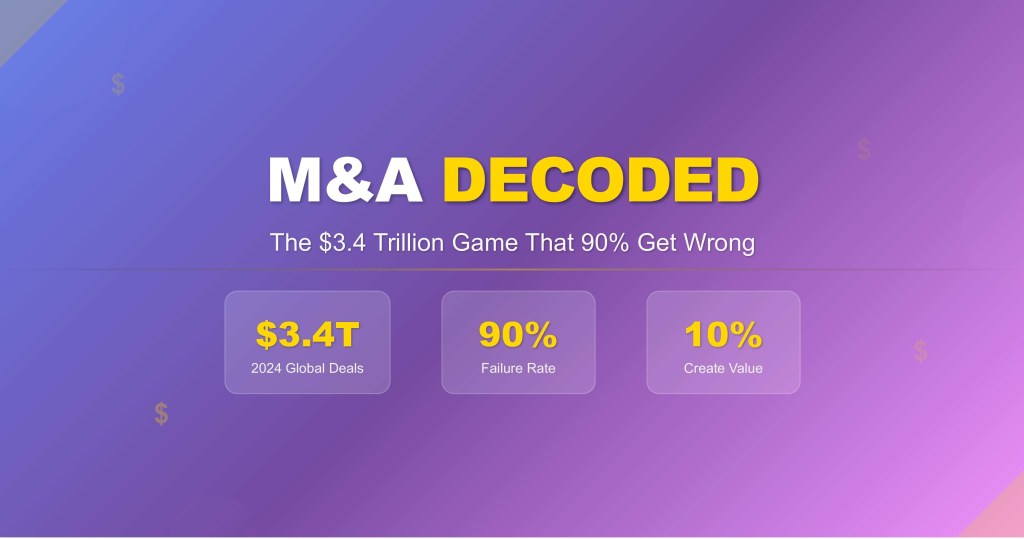
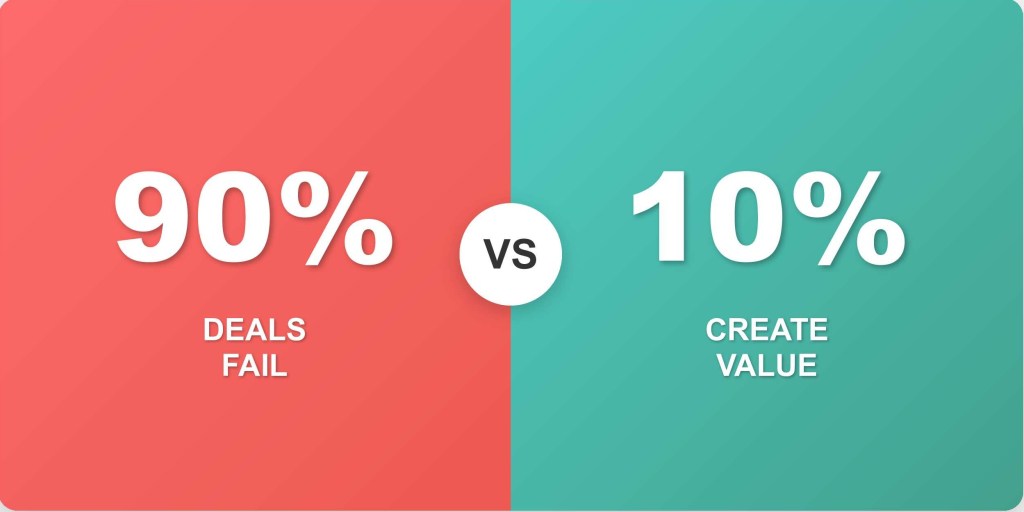
Why do smart executives keep betting billions on mergers and acquisitions when between 70% and 90% of these deals fail to create shareholder value?
The answer becomes even more intriguing when you consider that in 2024 alone, global M&A deals rose to $3.4 trillion.
This striking contradiction highlights one of the primary truths about contemporary business: although mergers and acquisitions are among the most effective growth strategies available to businesses in the modern world, they are also among the most challenging to execute and implement properly.
Think about it: if failure rates are so high, why do companies keep pursuing these deals? The reality is that when M&A works successfully and after thorough research with a clear purpose, it can transform entire industries overnight.
Throughout this exploration, we will unpack the different types of M&A deals, understand what drives companies to pursue them, and walk through the intricate process from initial negotiations to final integration. Further, you will also discover what separates the success stories from the cautionary tales with real-world examples and how these strategic moves continue to reshape the business landscape.
Types of Mergers and Acquisitions
When we talk about mergers, we are really discussing three distinct strategies:
- Horizontal merger occurs when two companies in the same industry merge to expand their market share and reduce instances of redundancy.
- Vertical mergers involve integrating firms in a supply chain, such as manufacturers and distributors, to become more efficient and gain control.
- Conglomerate mergers bring together businesses from different industries, typically aimed at diversification of risk and revenue streams.
Types of Acquisitions include:
From a structural standpoint, acquisitions may take the form of stock purchases or asset acquisitions. However, takeovers can be friendly (where the target company welcomes the buyer) or hostile (where the acquisition happens despite the management’s resistance), depending on whether the target company’s leadership consents to the transaction.
Understanding these categories enables stakeholders to tailor their approaches to legal compliance, negotiation, and integration.
Strategic Reasons for M&A
The motivations behind M&A deals have evolved far beyond simple rescue missions. The term’ Mergers and Acquisitions’ is often associated with the acquisition of a loss-making entity to protect the interests of stakeholders. However, Business markets have moved beyond that.
For instance, entering new markets through acquisition can compress years of organic growth into a single transaction. Synergies, viz. operational, financial, or technological, can lead to cost savings and increased productivity.
Moreover, M&A provides access to new product lines, intellectual property, and specialised talent. Some of the other reasons include:
- Credibility in the market is another critical driver. Acquiring or merging with a reputable company enhances brand perception, investor trust, and regulatory favourability.
- Leadership restructuring, particularly when management gaps exist, is also a common motivation behind acquisitions.
In all cases, a well-aligned M&A strategy can secure both immediate and sustainable competitive advantages.
The M&A Process: Step-by-Step Guide
The process of M&A has a pattern of development, which can be described as predictable but complicated and expected to last months and even years. The first stage is strategic planning, which is the process of determining goals, profiles to be targeted, and expectations of deal value. This is followed by an initial outreach and early-stage discussions, which typically lead to a Letter of Intent (LOI) and confidentiality agreements.
Once terms are agreed upon and regulatory approvals are secured, the deal is formally closed. The final and often most challenging stage is an integration to unite teams, systems, and strategies under a single, cohesive framework.

M&A Valuation Methods and Financial Considerations
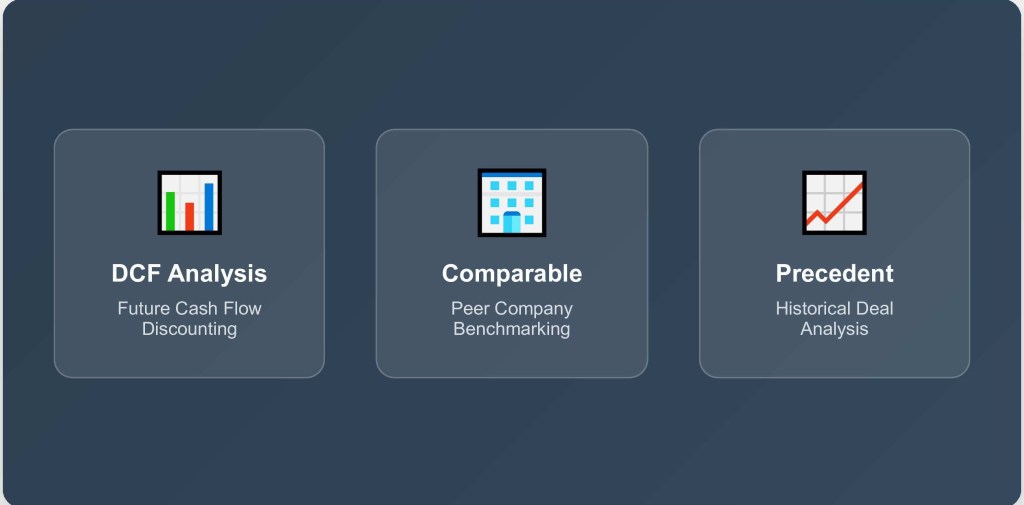
Ascertaining the fair value of a company is a foundation for successful M&A. Three widely accepted valuation techniques include:
- DCF analysis, i.e., estimation of cash flows in the future discounted to a present value.
- Comparable company analysis, which assesses peer valuations
- Precedent transaction analysis, which benchmarks similar past deals.
Financing the deal may involve cash payments, share transactions, or debt instruments.
Furthermore, tax implications ranging from asset depreciation benefits to capital gains liabilities require thorough scrutiny. These transactions will inevitably impact the acquiring company’s financial statements, altering key ratios and investor metrics.
Due Diligence in M&A Transactions
Due diligence acts as a risk filter in the M&A process. It encompasses:
- Financial due diligence broadly analyzes the historical performances and future projections.
- Legal due diligence, which verifies regulatory compliance, litigation history, and intellectual property.
- Operational assessments that examine infrastructure, supply chains, and processes.
Additionally, the most crucial due diligence is Technology due diligence, especially cybersecurity. Failing to consider these aspects can result in post-merger losses or reputational damage.
A meticulous and timely approach to due diligence mitigates such risks and enhances integration readiness.
Post-Merger Integration: Making M&A Successful
Many mergers and acquisitions (M&A) deals fail due to integration issues. Success depends on a robust change management plan, beginning with early-stage integration blueprints and well-defined leadership roles. Cultural compatibility should not be underestimated. Divergent work ethics or values can lead to friction and talent attrition.
Systems unification, communication synchronization, and performance measurement structures should be put in place as soon as possible. Open communication with the inner circles is essential in retaining good performers as well as establishing clarity and cohesion in the organisation. Monitoring of synergies and aligning strategies accordingly will entrench long-term value creation.
Successful M&A Examples:
1. Tata Motors’ Acquisition of Jaguar Land Rover (2008) – $2.3 Billion Turnaround
Strategies that made M&A & successful:
- Cultural Preservation: Tata maintained British leadership and design philosophy while adding Indian operational efficiency.
- Investment Commitment: Tata Motors-owned Jaguar Land Rover has maintained substantial annual investments, with plans for 3 billion pounds annually by FY26.
- Brand Autonomy: Kept Jaguar and Land Rover as separate luxury brands while sharing technology platforms.
- Local Market Access: Used Tata’s emerging market expertise to expand JLR into China and India.
The Result: JLR became profitable within three years, with revenues reaching £22.8 billion in fiscal 2023, demonstrating one of the most successful cross-border automotive acquisitions.
2. Disney’s Acquisition of Pixar (2006) – $7.4 Billion Creative Revolution
Strategies that made M&A & A successful:
- Creative Preservation: Disney allowed Pixar to maintain complete creative independence and preserve its unique culture and decision-making process.
- Integration Strategy: A unique blend of Pixar’s cutting-edge computer animation technology with Disney’s traditional storytelling expertise created a new standard for animated filmmaking across both studios.
- Leadership Retention: Pixar’s founder became Disney’s largest individual shareholder and board member, while all key creative talent remained with guaranteed creative control over their projects.
- Brand Synergy: Rather than blending the two, Disney kept Pixar’s unique identity intact, allowing both brands to shine while using its own global reach and merchandising power to amplify Pixar’s success.
The Result: Post-acquisition, Disney’s animation division was revitalized with hits like “WALL-E,” “Up,” and “Frozen,” transforming both studios into a creative powerhouse that continues to dominate animated entertainment globally.
3. Zoho’s Acquisition Strategy (2019-2024) – The Anti-Silicon Valley Approach
Strategies that made M&A & successful:
- Rural Tech Talent: Acquired 12 small software companies in Indian tier-2 cities, accessing talent at 60% lower costs than Bangalore.
- No Layoffs Policy: Every acquisition came with 5-year employment guarantees, creating unprecedented loyalty.
- Technology Integration: Built a unified platform from acquired tools instead of maintaining separate products.
- Bootstrap Philosophy: Used only internal cash flow, no external funding, giving complete strategic freedom.
The Result: Revenue grew from $500 million to $1.2 billion while maintaining a 40% profit margin and zero debt.
M&A Challenges and Common Pitfalls
Despite the best intentions, not every M&A deal has yielded its intended value. The statistics of the industry show that most mergers do not achieve strategic goals. Overestimation of efficiencies, cultural misalignment, regulatory challenges, and poor integration timing are the major causes typically cited.
A poor appreciation of the market conditions or overestimation of the prices may lead to high economic costs in the acquisition process. Further, potential regulatory problems can cause the demixing of transactions, especially in cross-border services, or delays in repayment.
Companies need to have contingency plans in place and also perform stress tests to be at the same level of preparedness for such situations.
Failed M&A Examples:
1. SoftBank’s Acquisition of WeWork Stake (2019-2021) – $18.5 Billion Evaporation
Reasons for failure:
- Due Diligence Blindness: SoftBank ignored WeWork’s negative unit economics in 80% of locations.
- Founder Dependency: Adam Neumann’s brand was inseparable from the company value, creating a single point of failure.
- Market Timing Disaster: Invested just before the pandemic killed shared workspace demand.
- Cultural Misalignment: Japanese corporate culture clashed completely with WeWork’s “startup” mentality.
- Integration Impossibility: WeWork’s decentralized model couldn’t integrate with SoftBank’s portfolio companies.
The damage: $18.5 billion write-down and WeWork’s bankruptcy within 2 years.
2. Walmart’s Acquisition of Jet.com (2016) – $3.3 Billion E-commerce Miscalculation
Reasons for failure:
- Founder Flight: Marc Lore left after 2 years, taking institutional knowledge and team loyalty.
- Technology Incompatibility: Jet’s dynamic pricing algorithm couldn’t integrate with Walmart’s fixed-price legacy systems.
- Customer Confusion: Jet’s urban millennial customer base had zero overlap with Walmart’s suburban family base.
- Operational Conflicts: Jet’s premium fulfilment promise conflicted with Walmart’s cost-efficiency model.
- Brand Cannibalization: Instead of expanding market share, Jet stole customers from Walmart.com.
The Outcome: Jet.com shut down in 2020, completing a $3.3 billion loss with zero strategic value retained.
3. General Electric’s Acquisition of Alstom Power (2015) – $10.1 Billion Energy Disaster
Reasons for failure:
- Market Timing Catastrophe: Acquired just as global power generation demand collapsed due to the renewable energy shift.
- Integration Complexity: French labour laws and union structures were incompatible with GE’s American cost-cutting approach.
- Technology Obsolescence: Alstom’s gas turbine technology became obsolete more quickly than projected due to the rapid acceleration of renewable energy.
- Regulatory Entanglement: European regulators blocked key integration synergies, preventing cost savings.
- Cultural Warfare: French engineering pride clashed with GE’s efficiency-focused culture, causing a talent exodus.
The Devastation: $22 billion write-down and GE Power’s eventual spin-off as a separate company.
Current M&A Trends and Market Analysis
In 2025, digital acceleration, environmental standards, and global volatility are expected to characterise the dynamics of M&A. A focus on M&A fuelled by technology, especially the use of artificial intelligence, cybersecurity, and SaaS platforms, is also observing sustained activity. The trend is reflected in an increase in cross-border mergers in the healthcare and energy industries, driven by innovation and cross-national policy changes.
Environmental, Social, and Governance (ESG) factors have become important criteria in determining deal-making decisions. Remote negotiations and virtual due diligence have been accepted as industry standards. At the same time, geopolitical volatility and national data protection laws are changing the structure and execution of cross-border M&A deals.

Business Content Writing in M&A
Clear, strategic communication is the backbone of every successful merger or acquisition. Business content writing adds clarity, trust, and cohesion at every stage of the M&A lifecycle. Here’s how:
- Pre-Deal Documentation: Writing compelling executive summaries, investment memorandums, and pitch decks that articulate deal rationale and value proposition.
- Legal Document Translation: Converting complex legal terms in LOIs, purchase agreements, and merger documents into accessible business language for stakeholders.
- Internal Communication: Crafting clear, consistent messaging for employees at all levels – from C-suite briefings to company-wide announcements that maintain morale and productivity.
- Shareholder Communications: Developing transparent, confidence-building content for investor relations, including quarterly updates, proxy statements, and deal progress reports.
- Customer Retention Content: Creating reassuring messaging that addresses customer concerns about service continuity, pricing, and relationship changes during the transition.
- Regulatory and Compliance Writing: Preparing clear, compliant documentation for regulatory filings, antitrust submissions, and government communications.
- Media and Public Relations: Developing consistent messaging for press releases, media interviews, and public statements that control the narrative and manage market perception.
- Post-Merger Integration Communications: Writing change management content, cultural integration guides, and unified brand messaging that smooths the transition process.
- Crisis Communication Preparedness: Drafting response templates and communication procedures in case of potential problems with the deal or public relations disasters.
Conclusion: Key Takeaways for M&A Success
The world of mergers and acquisitions (M&A) is undergoing rapid change. Still, one fact remains constant: deals can only succeed or fail depending on how the companies involved communicate with each other during the process. When your competitors concentrate exclusively on figures and structures, you now possess the framework to utilize communication as a competitive advantage.
The most successful M&A professionals in 2025 are not just financial wizards or legal tacticians, they are the master communicators who understand that every great deal is ultimately a great story told well.
Ready to transform your M&A communication strategy? I provide strategic business content writing that simplifies complexity and strengthens brand trust. Let’s work together to build your next milestone.
References Summary:
- https://www.mofo.com/resources/insights/250109-m-a-in-2024-and-trends-for-2025.
- https://hbr.org/2011/03/the-big-idea-the-new-ma-playbook.
- https://www.tata.com/business/jlr.
- https://www.business-standard.com/companies/news/jaguar-land-rover-plans-annual-investment-of-3-billion-pounds-by-fy26-123061200831_1.html.
- https://thewaltdisneycompany.com/disney-to-acquire-pixma/
- https://money.cnn.com/2006/01/24/news/companies/disney_pixar_deal/
- https://www.thehindubusinessline.com/info-tech/zoho-hiring-rural-india/article65770589.ece
- https://yourstory.com/2023/08/zoho-rural-tech-talent-india-strategy
- https://www.nytimes.com/interactive/2019/11/21/business/wework-softbank.html
- https://www.cnbc.com/2020/05/19/walmart-shutting-down-jetcom.html
- https://www.vox.com/2016/8/8/12401856/walmart-acquires-jet-ecommerce
- https://www.bloomberg.com/news/articles/2019-10-31/ge-s-alstom-deal-flop
- https://www2.deloitte.com/us/en/pages/mergers-and-acquisitions/articles/ma-trends-report.html
- https://home.kpmg/xx/en/home/insights/2023/03/esg-in-ma.html
- https://hbr.org/2016/06/why-do-so-many-mergers-fail
- https://irsociety.org.uk/
 Sundhara
Leave a comment